


How can a gardener use water efficiently?
In many parts of Estonia, boreholes and water treatment plants cannot produce enough water during drought periods due to excessive consumption. Using treated drinking water to water lawns is also a waste of this valuable natural resource. Therefore, it is important to use drinking water wisely and collect rainwater for irrigation instead.
- Environment
How can a gardener use water efficiently?
In many parts of Estonia, boreholes and water treatment plants cannot produce enough water during drought periods due to excessive consumption. Using treated drinking water to water lawns is also a waste of this valuable natural resource. Therefore, it is important to use drinking water wisely and collect rainwater for irrigation instead. Rainwater can also be used for other purposes that do not require spending high-quality drinking water, such as filling ponds or washing cars. However, bear in mind that if your building's roof contains asbestos or is covered in tar paper, rainwater will also carry toxic compounds.
A simple water tank or a complex harvesting system?
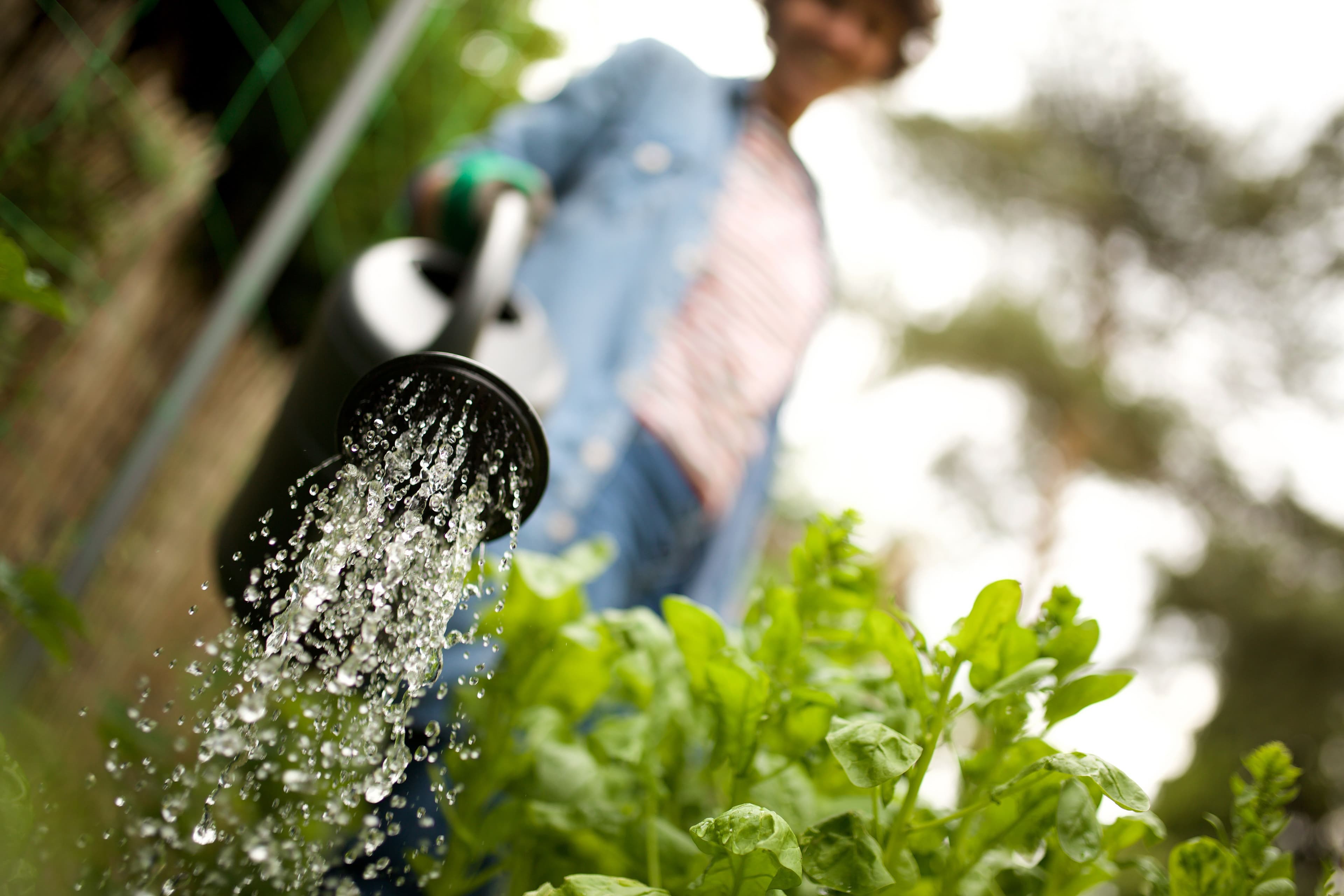
The cheapest and easiest solution for collecting stormwater is to buy a standard water tank and connect it to a rain gutter. This way, rainwater can be directed straight into the tank. You can fill your watering can from the tank and use it to water your plants. You can also mount a tap on your tank and connect a hose to it to transport water. With an average rainfall, a 72-square-metre roof can produce roughly 1,300 litres of rainwater within an hour. Therefore, the tanks should be large enough and equipped with an overflow to prevent flooding, directing water away from the building. To reduce water evaporation, place the tanks in a shadier location and cover them.
For watering the lawn, on the other hand, you will need to set up a more advanced harvesting system. For this purpose, you can choose from above-ground and underground tanks that come with a filter system and can be fitted with a pump for watering. Above-ground tanks are available in a variety of shapes, sizes and colours. An underground stormwater tank is buried close to the outlet of the drainage system. In this way, rainwater can be directed straight from the drainage system into the tank. Underground tanks also come in a flat shape that does not require extensive excavation for installation. Rainwater tanks last over 70 years and require virtually no maintenance.
The most universal solution is to use rainwater in the property's sewer system. In this way, collected rainwater can be used for domestic purposes, such as flushing toilets. The system comprises a collection tank, a filter, a pump, a compliant water metering unit and meters installed by the water utility. In order to build this kind of system, you first need to obtain technical specifications from the water utility to ensure that rainwater does not enter the public water supply network. Estonia already has apartment buildings where more than a third of the water used by the apartment association comes from rainfall.
Although buying a collection tank or setting up a complex system requires an initial investment, the benefits to both the consumer and the environment become apparent over time. The cost of buying and installing more common systems (such as a collection tank and a drainage pump) is around 2,000 euros.
If you have the space and suitable soil, one way to collect rainwater is to dig a pond in your garden. This will fill up with water over time by itself.
Another, two-in-one solution is the rain garden planter. This is a container filled with a suitable growing substrate and a drainage layer. It can be placed directly under the rainwater downpipe as a complete solution. In the warm season, the planter can be used to grow ornamental plants. The rain garden planter has six layers: vegetation (preferably local, flood-tolerant plants), a filtering soil layer (a 750–1000 mm thick layer of coarse, sandy material), a transition layer (a 100 mm thick transition layer, or, alternatively, geotextile), a drainage layer (collects water filtering through the soil layer), perforated pipes (these are not needed if the water seeps into the existing soil), and an overflow upstand (when the planter fills with water, excess water is directed through the overflow upstand directly into the perforated pipes).
Collecting stormwater helps urban areas to function
Collecting and using rainwater for irrigation is the most environmentally sustainable solution, so we recommend that all our customers do this. Collecting stormwater is also something that does good for our public urban space, as many of the surfaces in the city, such as asphalt and concrete, are impermeable, and prevent water from seeping away. The more stormwater people can collect and use themselves, the less we will have floodings caused by impermeable surfaces, and the lower the pollution load in stormwater and bodies of water from urban environments.